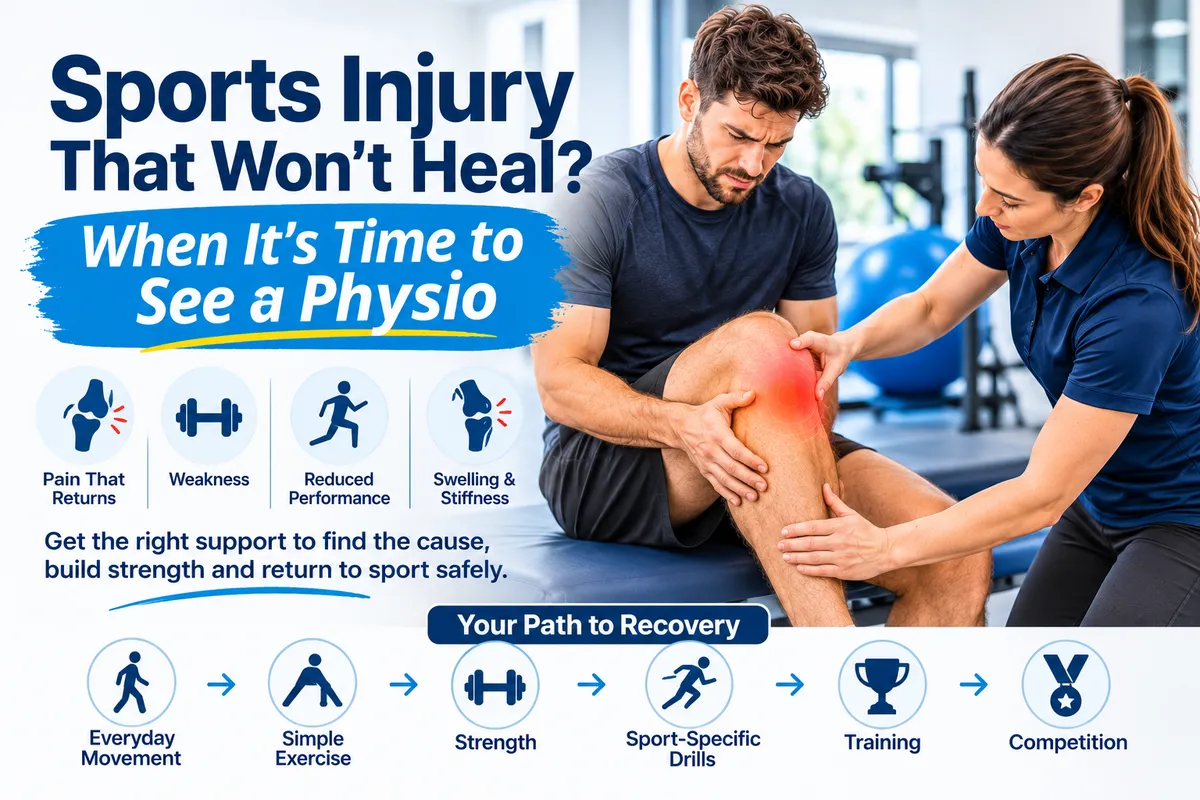
Sports Injury That Won’t Heal? When It’s Time to See a Physio
Quick answer: It's frustrating when a sports injury isn't getting better or keeps coming back. If it's affecting your strength, movement and performance, that's a sign you need the right support. With sports injury physiotherapy in Dublin, a physiotherapist can find the cause of your injury and help you rebuild strength to return to sport safely.
What causes a sports injury that won't heal?
There are many reasons that contribute to a longer healing process. One of the most common reasons behind this is returning to training too early, even before the injured area has become strong. It puts extra pressure on the injury and slows down your recovery process.
Maybe you will be fine with daily activities and think that you are fine now, but running, jumping, or lifting can put pressure on your body. This can cause the injury to return.
When should I see a physio for a sports injury?
When your pain is not getting better, or it keeps returning, you might consider visiting a physiotherapist. Pain, stiffness, swelling, or weakness on the injured area all are sign that you need help with your injury treatment. In such cases, do not wait, as it is possible that your injury may become severe.
A physiotherapist can check the injury, analyse your movement, as well as your strength and may suggest ways for your recovery.
Why does resting from a sports injury sometimes not fix it?
Taking rest only helps in reducing the pain; it cannot help you to build strength movement needed for the sport.
It feels like you are recovered now and ready for the sport again, but the injury can return once you come back to the sport.
It's because your body is still not ready for the same level of activity you played before you were injured.
In such cases, recovery requires more than rest. Exercises, gradual strengthening and controlled movement can help the body become ready for sport again.
Understanding Why Your Sports Injury Keeps Coming Back
Sports injuries have a pattern.
They start small.
Then they start changing what you do.
You avoid a movement.
Train around the injury.
Reduce your intensity.
Maybe change your technique without realising it.
You stop trusting the injured area.
Over time, the injury becomes part of how you move.
And that can make getting back to normal training more difficult.
WHY IT FEELS LIKE IT'S HEALING
This is where things can get confusing.
The pain settles.
You feel better.
You test it.
It seems fine.
So you return to normal training.
The first session goes well.
Maybe the second does too.
Then...
👉 It comes back.
This does not always mean you have injured the area again. It may simply mean that it is not strong or ready enough for the demands of your sport. Pain can settle before full strength and movement have returned.
That is why a gradual return matters.
WHEN IT STOPS BEING “JUST A NIGGLE”
At first, you might tell yourself it is nothing serious.
“It’s only bothering me a little.”
But little changes can start adding up.
A runner cuts their distance because longer runs hurt.
A footballer avoids sprinting.
A tennis player changes their serve.
A gym-goer skips certain lifts.
A cyclist notices symptoms after longer rides.
You are still participating.
But you are not really doing what you normally do.
And eventually:
“It’s only bothering me a little.”
becomes:
“I can’t train properly.”
That is an important point to take seriously.
THE PART MOST ATHLETES GET WRONG
There are two common extremes.
They stop completely
The injury settles.
Training stops.
But when the time comes to return, the body has not necessarily been progressively prepared for the demands of sport.
They return too quickly
The pain improves.
They feel ready.
So they go straight back to their previous training level.
The symptoms return.
You might see some improvement, but your body may still need more time to get ready to handle sporting activity. It is better to return to activity slowly and adjust it as your recovery improves.
WHAT'S ACTUALLY GOING ON
There is a difference between reducing pain and restoring capacity.
Your body may need to rebuild:
Strength
Mobility
Coordination
Load tolerance
Sport-specific movement
Confidence in the injured area
These things matter because your sport has its own demands.
A runner needs to tolerate repeated impact.
A footballer needs to run fast, stop and change direction.
A tennis player needs to reach, rotate and load the body repeatedly.
A gym-goer needs to tolerate resistance and lift heavier loads.
So rehabilitation should not only focus on making the injured area feel better.
It should also prepare that area for what you actually want to do.
WHAT SPORTS INJURY PHYSIOTHERAPY IN DUBLIN ACTUALLY INVOLVES
Treating a sports injury in Dublin involves more than just treating the pain.
A physiotherapist checks your symptoms, movement and activities to identify the real problem.
The treatment plan may vary depending on the person, injury and the sport the person is engaged in.
For someone who is returning to running, you need a different plan from someone going back to football or weight training.
Your exercises also become more challenging as your body progresses.
Here, the goal is not just reducing your pain.
But it is also to help you to get back to the sport again.
When Things Start to Improve
Recovery feels difficult when you feel there is no progress.
Then small things start changing.
Training becomes more consistent.
Strength starts returning.
Movement feels easier.
The injury becomes less reactive.
Sport-specific activity can gradually be introduced again.
And eventually, something else changes.
👉 You stop thinking about the injury every time you move.
Now, you can focus on your training rather than constantly thinking that this move will hurt you.
And that's an important part of coming back to the sport.
THE PART PEOPLE DON'T EXPECT
The injury also affects your confidence along with physical ability.
After avoiding movements on an injured area for a long time, you may feel nervous before jumping, changing direction, or lifting.
You may know physically that you can do something.
But you still hold back.
That is usual.
A recovery programme helps in building your physical capacity again, along with giving you confidence to become comfortable with those movements again.
The goal is not to rush through the process.
But it is to give challenges to your body at the right stage.
WHAT DOES A SAFE RETURN TO SPORT LOOK LIKE?
Coming back to sport usually happens slowly rather than all at once.
Here's a simple example of it:
Your Everyday movement → Simple exercise → Strength → Sport-specific drills → Training → Competition
The recovery plan varies from person to person depending on their injury, symptoms, and demand of the sport.
For example, one person may increase their speed slowly, while another person may need to improve their strength to run or jump.
The main idea behind it is that you should not return to sport just because the pain disappears, but to train your body to become strong enough to return to sport.
A Simple Way to Think About Your Return
Notice the pattern if the injury is coming back, rather than just simply waiting for the pain to disappear.
What happens when training starts?
Does the pain appear during the activity?
Afterwards?
The next day?
What has changed?
Have you reduced the distance, speed, weight or intensity?
What can you currently tolerate?
Are you able to manage everyday movement but only struggle with sport-related activity?
All these questions will help you to identify why returning back to your previous training level is hard.
A physiotherapist can analyse the problem and help to determine the appropriate steps based on your condition.
What is the best sports injury clinic in Dublin?
If a sports injury is stopping you from training or doing whatever you love to do. Consulting with the right sports injury clinic in Dublin can help you.
The right physio may check your injury, movements, symptoms and the sport you play.
Maybe you want to get back to running.
Maybe the gym.
Maybe football, rugby or another sport you enjoy.
At Sport Physio Ireland, they empahises more on understanding the injury and helping you to rebuild your strength.
The aim is not only to reduce pain.
👉 It is also about helping your body get ready for sport again.
FINAL THOUGHT
Don't feel unlucky if your injury keeps coming back.
Or it doesn't mean that you can't play the sport you love.
But it only means that your body is not ready for the demands of your sport.
Rest can help to settle other symptoms.
But getting back to the sport requires building strength, movement and capacity.
Are you also struggling with an injury that is not healing or coming back after returning to training? Reach out to Sports Physio Ireland today and consider booking a physiotherapy assessment to find out what's keeping you stuck.
Frequently Asked Questions
Why does the same movement keep causing discomfort after a sports injury?
It is because the tissue is not strong enough to handle the demands of your sport; Hence, it causes discomfort.
What happens if I ignore a recurring sports injury for a long time?
Ignoring a recurring sports injury can make it more severe if it is treated the same way for a long time.
Does every sports injury need the same type of rehabilitation?
No, every sport has a different kind of rehabilitation depending on the sport type.
Can physiotherapy help if I am still able to play my sport?
Yes, physiotherapy can help you if you are still able to play your sport. It is not only to recover when you are injured but also helps in many other ways, such as improving your performance.
Can I check whether I am progressing during sports injury rehabilitation?
Yes, you can check your progress by checking your pain level, strength, and movement.
About the Author:
Written by Joseph Boland, Clinical Director, Sports Physio Ireland. Joseph has been treating sports injuries and musculoskeletal conditions in Dublin for over 10 years. He holds a BSc in Physiotherapy and is a member of the Irish Society of Chartered Physiotherapists (ISCP). Sports Physio Ireland has two Dublin clinics - Dublin 2 (Fitzwilliam Street Upper) and Dublin 7 (Cabra) - and is Dublin's most reviewed physiotherapy clinic with over 1,500 five-star reviews.
